Custom Ship Model Manufacturing Guide
What Affects the Cost of a Large Ship Scale Model?
Discover what determines the cost of a large custom ship model,
from vessel dimensions and scale to engineering details, materials,
production quantity, display cases and international shipping.
Learn how to prepare your project information and obtain a more
accurate quotation from a professional ship model manufacturer.
Explore Custom Ship Models
Large Project Guide
A large ship scale model can serve as a centerpiece in a corporate
headquarters, shipyard showroom, maritime museum, exhibition hall
or engineering presentation. Unlike a standard decorative model,
a custom project may need to reproduce the proportions, equipment,
markings and structural details of a specific real vessel.
The cost of a large ship model is therefore determined by more than
its finished length. Design complexity, available drawings, material
selection, finishing requirements, order quantity, display solutions
and transportation arrangements all contribute to the final quotation.
Merialuksen mallit
develops custom scale models for commercial vessels, offshore
projects, shipyards, shipowners, museums and corporate applications.
Understanding the factors below can help you define your requirements
and choose a suitable solution for your project.
A custom marine model illustrates how vessel-specific structures,
surface finishing and presentation requirements influence a project.
1. Model Size and Scale
Model dimensions are among the first factors to consider when
estimating the cost of a large ship scale model. A larger model
generally requires more material, a larger working area and additional
time for assembly, painting, detailing and inspection.
However, the original vessel's length does not determine the final
model size by itself. The selected scale is equally important.
A large commercial vessel reproduced at 1:100 scale will have
different physical dimensions from the same vessel reproduced at
1:300 scale.
How to Calculate the Finished Model Length
Model length = Actual vessel length ÷ Scale denominator
For example, a 200-meter vessel reproduced at 1:200 scale has
a nominal model length of 1 meter, excluding the display base
and protective case.
| Actual Vessel Length |
Scale |
Nominal Model Length |
Potential Cost Consideration |
| 200 m |
1:500 |
40 cm |
Smaller physical footprint |
| 200 m |
1:300 |
66.7 cm |
Moderate display size |
| 200 m |
1:200 |
100 cm |
Larger structure and display requirements |
| 200 m |
1:100 |
200 cm |
More demanding fabrication and transport |
These are illustrative calculations rather than price categories.
A smaller model with extremely fine details can cost more than a
larger, relatively simple model. The appropriate scale should be
selected according to the available display space, desired level
of realism, budget and transportation requirements.
2. Vessel Complexity and Level of Detail
Two models of the same length can have significantly different
production costs. A simple vessel with a relatively open deck may
require less detailed fabrication than an offshore construction
vessel equipped with multiple cranes, lifting systems, platforms,
pipes, winches and specialized machinery.
The more vessel-specific components that need to be reproduced,
the more design, fabrication, assembly and finishing work may
be required.
Hull and Superstructure
The bow, stern, hull profile, bridge, accommodation blocks,
funnels and deck levels establish the vessel's overall shape.
Deck Machinery
Cranes, lifting equipment, winches, piping, cargo equipment
and other machinery can increase component count and assembly time.
Fine Details
Railings, ladders, antennas, lifeboats, cables, windows and
small fittings may require individual production and installation.
Painting and Identification
Complex color schemes, hull markings, company logos and vessel
names may require additional preparation, masking and finishing.
Consider the
customized POSEIDON offshore vessel model
as an example of a technically detailed vessel. Its cranes,
lifting structures, working platforms, railings and deck equipment
illustrate why model complexity can matter as much as overall size.

An offshore vessel model with visible deck equipment and a
customized display base. Additional specialist structures may
increase design and fabrication requirements.
3. Materials and Manufacturing Methods
Material selection affects the appearance, weight, structural
requirements and manufacturing process of a custom ship model.
There is no single material that is best for every vessel or scale.
The appropriate combination depends on the intended use, the
required level of detail and the characteristics of the design.
| Material or Method |
Typical Application |
Potential Cost Factors |
| Wood |
Handcrafted hulls, traditional structures and display models |
Shaping, assembly, surface preparation and finishing |
| Resin and 3D Printing |
Complex shapes and selected detailed components |
Digital preparation, print time, material and post-processing |
| ABS and Other Plastics |
Selected structures, housings and fabricated components |
Part fabrication, assembly and finishing |
| Metal and Brass |
Selected fittings, supports and fine structural details |
Machining, forming, joining and polishing |
| Mixed Materials |
Projects combining structural parts and detailed components |
Coordination of different fabrication and finishing methods |
Marine Ship Models combines traditional model-making techniques
with CAD design, 3D printing and CNC processing where appropriate.
The final manufacturing approach depends on the vessel, model scale
and project specifications.
For a large museum or corporate model, the best solution is not
necessarily the most expensive material. A well-planned combination
of materials can provide an appropriate balance of appearance,
structural stability, detail and cost.
4. Engineering Drawings and Reference Information
The quality and completeness of the available vessel information
can affect the amount of preparation required before production.
General arrangement drawings, hull lines, deck plans, CAD files
and clear photographs help the model maker understand the actual
vessel's proportions and configuration.
Projects With Engineering Drawings
When suitable technical drawings are available, the model maker
can use them to establish principal dimensions, structural
relationships and major component locations. This can reduce
uncertainty during the design stage.
Projects Based on Photographs
Models can often be developed from photographs and known vessel
dimensions. However, additional views, measurements and reference
checks may be needed to reconstruct features that are hidden
or difficult to interpret.
Complex or Incomplete References
If important vessel information is missing, additional research,
digital reconstruction or design revisions may be necessary.
The amount of work depends on the vessel's complexity and the
required level of accuracy.
To help prepare an accurate quotation, provide:
vessel name and type, actual dimensions, preferred scale or finished
length, GA drawings, hull lines, photographs, CAD files, color
references and details of any specialist equipment.
Read our
guide to choosing a ship model manufacturer for a large project
for more information about technical capabilities, project planning,
quality control and production requirements.
5. Production Quantity and Economies of Scale
The number of models ordered can influence both the unit price
and the overall project budget. A single large exhibition model
may require substantial individual design and fabrication work.
An order for multiple identical models may allow some design,
tooling and production preparation costs to be shared.
However, ordering more units does not automatically guarantee
a lower unit price. Each model still requires materials, assembly,
finishing, inspection and appropriate packaging.
SINGLE MODEL
One-Off Projects
Design preparation and setup costs are allocated to one model.
This may be suitable for a museum centerpiece, flagship vessel
display or executive presentation.
MULTIPLE MODELS
Repeat Production
Shared design work and repeatable components may improve
production efficiency when several models use the same
approved specifications.
CORPORATE ORDERS
Bulk Gift Programs
Quantity, model dimensions, presentation options and delivery
schedule should be confirmed together to evaluate the project
as a complete order.
MULTI-VESSEL PROJECTS
Different Model Designs
Orders involving different vessel types may require separate
design work even when the total quantity is high.
For a bulk order, ask the manufacturer to clarify which costs
are shared across the project and which apply to each individual
model. This makes it easier to compare quotations on a consistent basis.
6. Display Bases, Acrylic Cases and Transport Packaging
A large ship model is often purchased for professional display.
The display base, identification plaque, protective case and
shipping package should therefore be considered as part of
the complete project rather than added at the last minute.
Display Base
A suitable base supports the model and provides a finished
presentation. Its size, material, shape, supports and engraved
plaque can all affect the quotation.
Acrylic Display Case
A display case can help protect the model from dust and accidental
contact. Larger cases require appropriate dimensions, support
and handling arrangements. Case height and width should account
for masts, cranes, antennas and other protruding components.
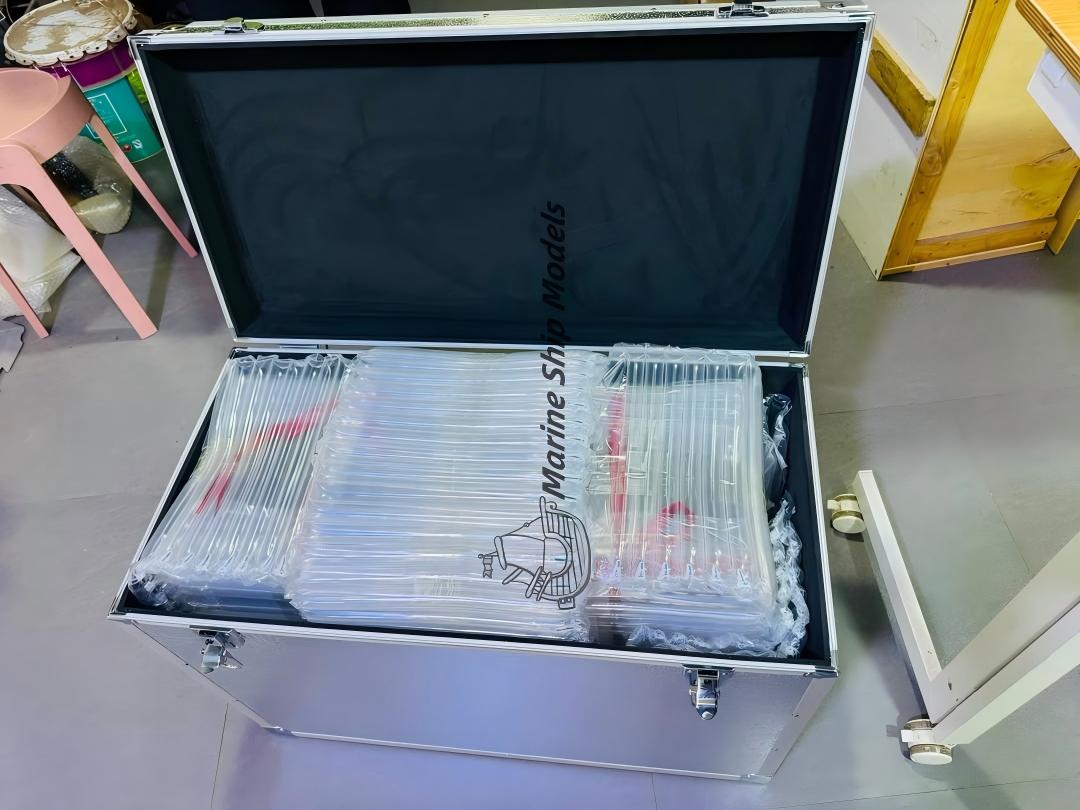
Protective Transport Crate
International shipping requires a different set of considerations
from indoor display. A large model may need protective internal
supports, impact-resistant packing and a transport crate designed
around its final packed dimensions.
Fragile components such as railings, masts, crane booms and
antennas should be considered when planning how the model will
be secured during transportation.

The display base and model dimensions should be considered together
when planning presentation and transportation.
Important: Ask whether the quotation includes
the display base, acrylic case, internal protective packing,
outer transport crate, shipping charges, insurance and destination
delivery. These items may be quoted separately depending on
the supplier and project requirements.
7. International Shipping and Delivery Destination
The cost of delivering a large ship model depends on its final
packed size, shipping weight, destination, transportation method
and handling requirements.
A model that fits within a compact parcel may be shipped by courier.
Larger models with oversized cases or crates may require a different
transportation arrangement. The most suitable method depends on
the complete package dimensions, weight and destination.
When comparing quotations, clarify the delivery terms and whether
the quoted price includes export packing, international freight,
insurance, customs clearance and final delivery. Import duties
and taxes may be additional depending on the agreed terms.
For oversized museum models or exhibition projects, it is useful
to confirm the entrance dimensions, elevator capacity, installation
area and delivery access at the destination before finalizing
the packaging.
8. How to Compare Large Ship Model Quotations
Two quotations may look very different even when they refer to
the same vessel. One supplier may include a protective case and
transport crate, while another may quote only the model itself.
One may allow more time for complex detailing, while another
may propose a simpler level of reproduction.
To make a fair comparison, ask each manufacturer to specify
the scope of work and all included items.
| Quotation Item |
What to Confirm |
| Model dimensions |
Scale, finished length, width and height |
| Detail level |
Hull, superstructure, machinery, railings and markings |
| Materials |
Proposed materials and manufacturing methods |
| Design work |
Reference review, digital design and approval requirements |
| Quantity |
Unit price, total price and any quantity-based adjustment |
| Display accessories |
Base, supports, plaque and acrylic display case |
| Packaging |
Internal protection, outer crate and packed dimensions |
| Shipping |
Destination, delivery method, insurance and import charges |
A clear quotation helps you understand not only the initial price
but also the full cost of completing, displaying and delivering
the model.
9. Practical Ways to Manage Your Project Budget
If you have a fixed budget, you do not necessarily need to abandon
the project or select the smallest possible scale. A more effective
approach is to prioritize the details that matter most to the
intended application.
-
Select the scale carefully.
Choose dimensions that suit the display space and viewing distance.
-
Prioritize recognizable vessel features.
Focus on hull proportions, superstructure, company colors,
vessel name and important equipment.
-
Provide complete references.
Clear drawings and photographs can reduce uncertainty during
design and production.
-
Plan the display case early.
Coordinate the model, base and case dimensions to avoid
unnecessary redesign.
-
Confirm the quantity at the beginning.
A planned batch can be evaluated more efficiently than
separate orders placed at different times.
-
Discuss delivery before production.
Large models may need special packing and transport planning.
These measures help align the design with the project's objectives.
The goal is not simply to reduce the initial quotation, but to
obtain a model that meets the intended visual, technical and
presentation requirements.
10. What Information Do You Need for an Accurate Quote?
Before requesting a quotation, prepare as much of the following
information as possible. You do not need to have every document
ready to start a discussion, but additional details will help
the manufacturer assess the project more accurately.
- Vessel name and vessel type.
- Actual vessel length, beam and other known dimensions.
- Preferred scale or approximate finished model length.
- General arrangement drawings, hull lines, CAD files or photographs.
- Required level of detail and special equipment.
- Preferred materials or any specific manufacturing requirements.
- Order quantity and whether multiple units share the same design.
- Display base, engraved plaque and acrylic case requirements.
- Required completion date and intended use.
- Delivery destination and preferred shipping arrangement.
Marine Ship Models can review available drawings, photographs and
other technical references to discuss a suitable custom manufacturing
approach for your vessel.
Frequently Asked Questions
How much does a large ship scale model cost?
There is no single price for every large ship model. The quotation
depends on finished dimensions, vessel complexity, detail level,
materials, design requirements, quantity, display accessories,
packaging and delivery destination. Providing your project details
is the best way to obtain a meaningful estimate.
Does a larger ship model always cost more?
Not necessarily. Size is an important factor, but a smaller model
with complex cranes, detailed machinery and extensive finishing
may require more work than a larger model with simpler structures.
Will ordering multiple models reduce the unit price?
It may. Shared design preparation and repeatable components can
improve production efficiency when several models use the same
approved specifications. The actual pricing depends on quantity,
complexity and production requirements.
Can you build a model without original engineering drawings?
Many projects can start with photographs and known vessel
dimensions. The amount of additional research and design work
depends on the vessel's complexity and the quality of the
available references.
Are the display case and transport crate included?
They should be confirmed in the quotation. Display cases,
protective internal packing, transport crates and international
shipping may be included or quoted separately depending on
the project requirements.
How can I reduce the cost without compromising the overall result?
Consider the model scale, prioritize important vessel features,
provide clear reference materials and confirm the quantity early.
Discuss the intended display environment with the manufacturer
so that the design can be matched to your budget and requirements.
Request a Quote for Your Large Ship Model Project
Planning a large museum model, shipyard presentation, corporate
display or multiple-model order? Share your vessel information
and project requirements so the appropriate scale, detail level,
materials, display accessories and delivery arrangements can
be evaluated together.
To get started, prepare your vessel name, drawings or photographs,
preferred model dimensions, quantity and delivery destination.
Contact Marine Ship Models
Read the Large Project Guide



 Suomi
Suomi  English
  Dansk
Dansk  Deutsch
  한국어
한국어  Français
  Italiano
  Bahasa Indonesia
  日本語
日本語  Polski
  Português do Brasil
  简体中文
简体中文  Türkçe