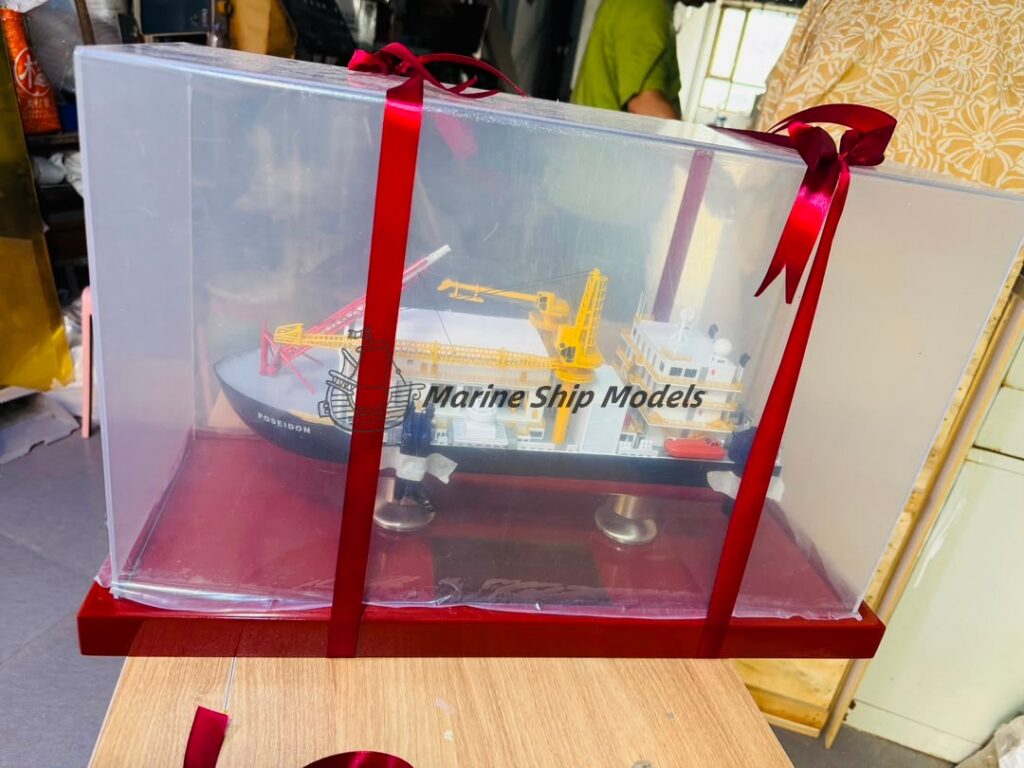
We are pleased to announce the successful completion and delivery of a customized marine ship model – POSEIDON, a detailed display model created to reproduce the distinctive appearance, structural layout, and working characteristics of a specialized offshore vessel.
This project was developed as a fully customized marine model rather than a standard off-the-shelf ship replica. From the hull profile and superstructure to the deck machinery, cranes, lifting systems, railings, working platforms, and color arrangement, every major visible element was carefully produced to give the finished model a professional and realistic appearance.
For companies operating in the marine, offshore engineering, shipbuilding, oil and gas, port, logistics, and heavy equipment industries, a customized ship model is more than a decorative object. It can represent a vessel, an engineering achievement, a completed project, a corporate milestone, or an important part of a company’s history.
The completed POSEIDON ship model is designed for long-term display in offices, meeting rooms, reception areas, exhibition halls, museums, maritime academies, shipyards, corporate headquarters, and customer presentation rooms.
A Custom Marine Model Built Around the Original Vessel
Every vessel has its own identity.
Unlike mass-produced ship models, a customized model needs to reflect the recognizable characteristics of the original vessel. For the POSEIDON project, particular attention was given to the vessel’s overall proportions and its distinctive offshore working configuration.
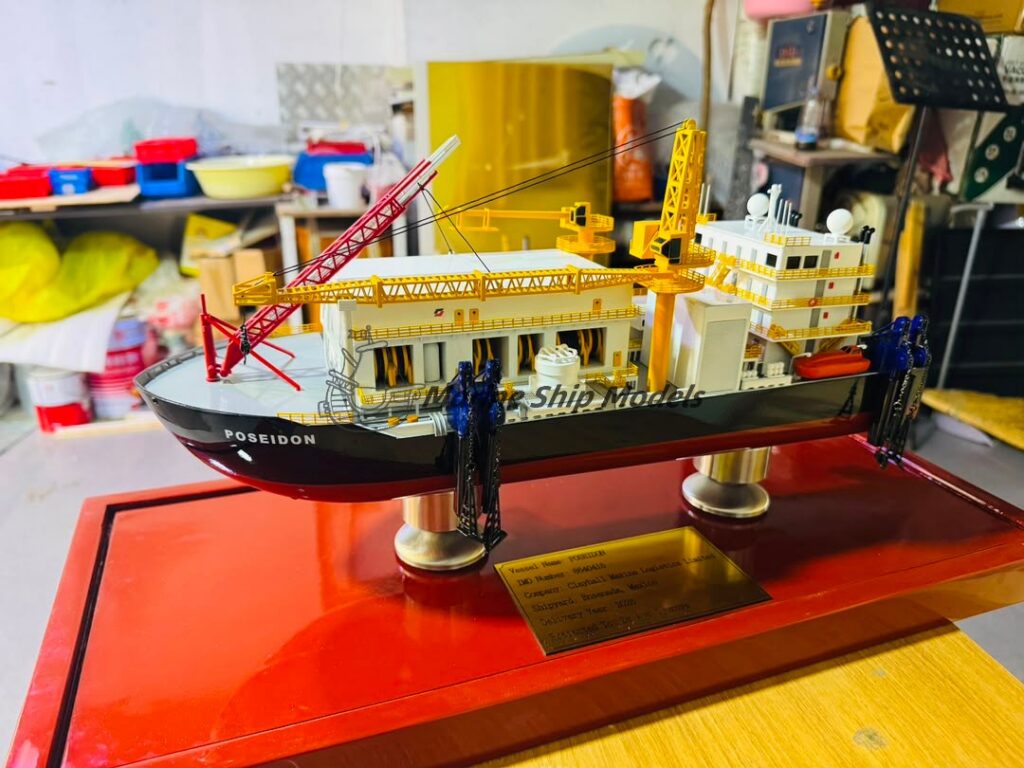
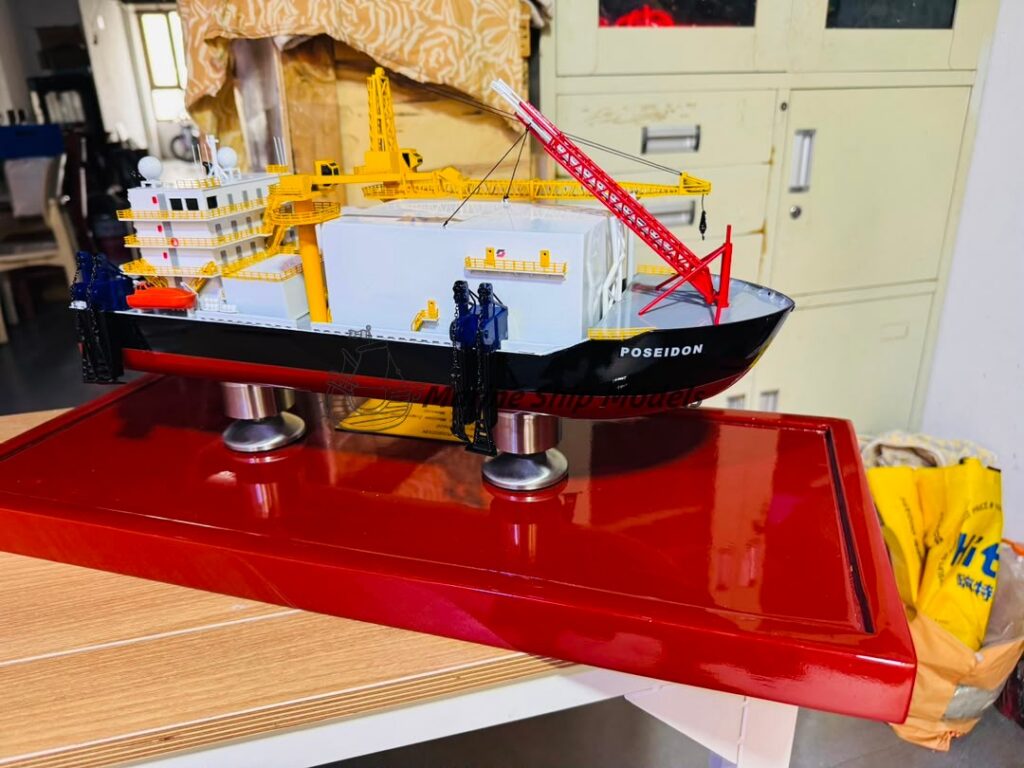
The model features a black and red hull combined with a white and yellow upper structure, creating a strong visual contrast that immediately gives the vessel a professional offshore engineering appearance.
The name POSEIDON is clearly displayed on the forward section of the hull, making the model immediately identifiable.
Above the main deck, a variety of structures and equipment have been reproduced, including:
- Main deck working areas
- Offshore lifting equipment
- Large crane structures
- Boom and cable details
- Superstructure and bridge sections
- Deck platforms
- External stairways
- Guardrails and safety railings
- Small auxiliary equipment
- Lifeboat details
- Machinery areas
- Antennas and communication equipment
- Vertical lifting and handling structures
These components work together to create a model that has visual depth from every viewing angle.
Whether viewed from the bow, stern, port side, starboard side, or from above, the model presents a strong three-dimensional representation of a complex working vessel.
Detailed Crane and Offshore Equipment Reproduction
One of the most visually impressive characteristics of this POSEIDON model is the reproduction of its crane and lifting equipment.
Specialized marine and offshore vessels often contain complicated deck machinery, making crane construction one of the most challenging parts of a custom ship model.
The model includes several crane-related structures with detailed lattice booms, rotating bases, lifting cables, support frames, hooks, and deck-mounted systems.
Because these components are relatively thin compared with the main hull, they require careful production and assembly.
The goal is not simply to add a crane-shaped structure to the deck. The crane must also match the visual proportions of the vessel so that the entire model remains balanced and realistic.
The combination of yellow and red crane structures creates an industrial appearance closely associated with offshore construction, heavy lifting, marine engineering, and specialized vessel operations.
Fine black cable details running between different crane components further enhance the model’s realism.
Accurate Deck Layout and Superstructure
The deck arrangement is another important element in customized marine model manufacturing.
On POSEIDON, the working deck contains several individual zones. Rather than presenting the vessel as one simple surface, the model includes different equipment areas, platforms, machinery housings, lifting structures, and access routes.
The white superstructure toward the stern provides another focal point.
Multiple levels are clearly represented, together with windows, external decks, yellow railings, access platforms, antennas, radar-related components, and other small marine details.
Small-scale elements can have a large impact on the final appearance of a model.
For example, railings, ladders, stairs, windows, doors, platforms, handrails, lifeboats, equipment boxes, ventilation details, and communication structures help transform a basic ship-shaped object into a convincing miniature vessel.
For corporate display models, this level of detail is especially important because the model may be inspected at close range by customers, shipowners, engineers, employees, and industry professionals.
Professional Color Matching
Color is one of the first things people notice when viewing a ship model.
The POSEIDON model uses a strong combination of black, dark red, white, yellow, blue, and metallic details.
The lower hull and waterline area feature a deep red tone, while the main upper hull is primarily black. The superstructure is finished in white, with yellow safety railings and equipment creating additional visual contrast.
Several deck machinery components are finished in blue and black, allowing individual pieces of equipment to remain visually distinguishable.
For custom marine models, colors can normally be reproduced according to customer references, vessel photographs, technical drawings, company standards, or specified color codes.
This is especially valuable when a model is produced as part of corporate branding.
A vessel’s color scheme is often closely connected with the identity of the shipowner or offshore operator. Maintaining consistent colors therefore helps make the finished model immediately recognizable.
Customized Display Base
A high-quality marine model also requires a suitable display platform.
For this POSEIDON project, the vessel is mounted on a polished wooden base that creates a strong contrast with the industrial appearance of the ship.
Metallic supports elevate the vessel above the base so that the hull remains clearly visible.
This method of presentation allows viewers to appreciate not only the deck equipment but also the shape and lines of the vessel itself.
A customized information plate is positioned on the front section of the base, providing an appropriate location for project information such as:
- Vessel name
- Ship type
- Company name
- Vessel owner
- Shipbuilder
- Project name
- Delivery date
- Scale
- Technical information
- Commemorative message
Corporate logos or customer-specific text can also be incorporated when required.
The result is a complete presentation piece rather than simply a standalone miniature ship.
Customized ship model production normally begins with the collection of reference information.
Depending on the project, the customer may provide:
- General arrangement drawings
- Vessel photographs
- CAD drawings
- Ship specifications
- Side-view drawings
- Deck plans
- Color references
- Company logos
- Equipment photographs
- Vessel name and markings
- Previous project images
Where complete engineering drawings are unavailable, a model can often still be developed by combining photographs with basic dimensional information.
The more reference information available, the easier it is to reproduce specific vessel characteristics.
After the vessel structure has been confirmed, the model is divided into individual manufacturing sections.
The hull, superstructure, cranes, deck machinery, railings, lifting equipment, antennas, platforms, and small fittings are produced separately before final assembly.
This approach allows each component to be adjusted before installation.
During final assembly, the model begins to take on the appearance of the actual vessel as the individual structural sections are brought together.
The POSEIDON project demonstrates the type of complex vessel that can be reproduced as a customized display model.
Custom model manufacturing can be used for many different marine vessel categories, including:
Offshore Construction Vessels
These vessels often contain cranes, working decks, lifting systems, and specialized offshore equipment.
Platform Supply Vessels
PSV models can reproduce large cargo decks, bridge structures, supply equipment, and offshore service configurations.
Anchor Handling Tug Supply Vessels
AHTS models can include towing equipment, winches, stern rollers, deck machinery, and anchor-handling systems.
Heavy-Lift Vessels
Large cranes, lifting booms, deck systems, and heavy cargo configurations can be reproduced.
컨테이너 선박
Customized container vessel models can include company colors, container stacks, vessel names, and shipping line branding.
벌크 캐리어
Bulk carrier models can reproduce cargo holds, hatch covers, cranes, bridge structures, and deck arrangements.
Tankers
Oil tanker, chemical tanker, LNG, and LPG vessel models can be produced according to specific vessel characteristics.
Ro-Ro and Car Carrier Vessels
These models are suitable for shipping lines, vehicle logistics companies, ports, and shipbuilders.
Tugboats and Workboats
Smaller commercial vessels can also be reproduced with detailed deck equipment and company branding.
Research and Survey Vessels
Specialized scientific equipment, communication systems, cranes, and deck layouts can be represented.
This makes custom ship models suitable for a wide range of marine businesses.
More Than a Model – A Corporate Display Piece
A professionally produced ship model often carries significant meaning for the company receiving it.
For a shipowner, it may represent a flagship vessel.
For a shipyard, it can commemorate the successful completion of a newbuilding project.
For an offshore engineering company, it can represent years of engineering work and offshore operations.
For a port or logistics organization, it can become part of a maritime exhibition.
For employees, customers, and business partners, the model provides a physical representation of the vessel that photographs alone cannot provide.
This is why customized marine ship models are frequently used for:
- New vessel delivery ceremonies
- Ship launching events
- Company anniversaries
- Shipowner gifts
- Shipyard gifts
- Offshore project completion ceremonies
- Corporate exhibitions
- Maritime museums
- Customer meeting rooms
- Executive offices
- Industry exhibitions
- Marine engineering presentations
- Company reception areas
A well-made ship model can remain on display for many years, continually reminding visitors of the original project.
Quality Inspection Before Delivery
Before delivery, a customized marine model should be carefully inspected.
The inspection process typically covers the main structure, surface finish, color consistency, deck layout, equipment installation, railings, antennas, cranes, markings, vessel name, display base, and overall visual appearance.
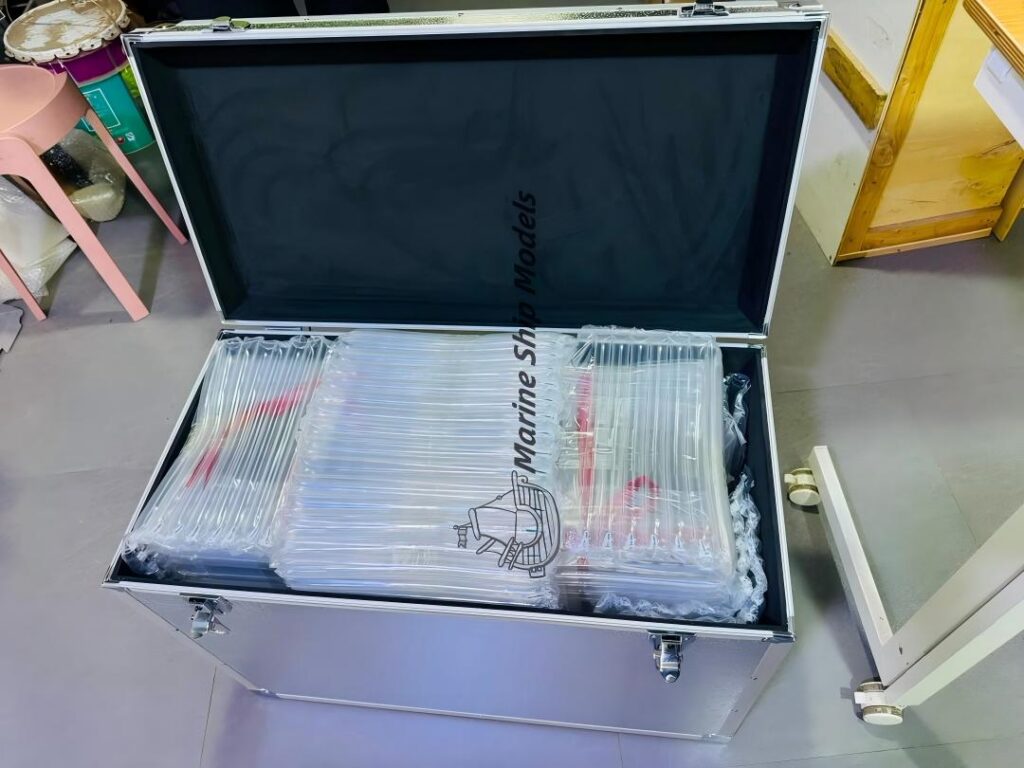
Special attention must be given to fragile components.
Crane booms, antennas, cables, railings, ladders, and other fine details can easily be damaged if the model is not properly secured.
For this reason, final packaging is an important part of the delivery process.
The objective is to ensure that the model arriving at the customer’s location maintains the same condition and presentation quality as when it leaves the workshop.
POSEIDON Successfully Completed and Ready for Display
The completion of the customized POSEIDON marine ship model represents another successful bespoke vessel model project.
Its detailed offshore working deck, distinctive crane structures, layered superstructure, realistic hull design, fine deck equipment, customized vessel markings, and professional wooden display base work together to create a strong visual representation of the original ship.
Every customized ship model tells a story.
It may tell the story of a vessel built by a shipyard, a difficult offshore project completed successfully, a shipping company’s growth, or an important milestone in a marine company’s history.
The POSEIDON model is designed to preserve that story in physical form.
For companies looking for custom ship models, marine vessel models, offshore vessel models, shipyard presentation models, corporate maritime gifts, or customized scale vessel replicas, models can be developed according to vessel drawings, photographs, technical information, and individual branding requirements.
From the first reference drawing to final assembly and delivery, the goal is always the same:
to transform a real marine vessel into a detailed miniature model that can be proudly displayed for years to come.
Marine Ship Models Customize – POSEIDON
Project: Customized POSEIDON Marine Vessel Model
Application: Corporate display / vessel delivery / commemorative model
Customization: Vessel structure, colors, cranes, deck equipment, ship name and display base
Suitable For: Shipowners, shipyards, offshore companies, marine engineering companies, ports and maritime organizations
Customization Available: Vessel name, logo, scale, color, information plate, display base and protective display case
POSEIDON has now been successfully completed and delivered — turning a remarkable marine vessel into a lasting miniature representation of engineering, craftsmanship, and maritime achievement.



 한국어
한국어  English
  Dansk
Dansk  Deutsch
  Français
  Italiano
  Suomi
Suomi  Bahasa Indonesia
  日本語
日本語  Polski
  Português do Brasil
  简体中文
简体中文  Türkçe