

In today’s interconnected marketplace, B2B buyers from Africa, South America, the Middle East, and Europe face unprecedented complexity when sourcing maritime equipment, components, or services. The “Navigation Model” framework equips them with a systematic way to chart a clear course through supplier selection, material choices, and cost optimization—ensuring that every procurement decision sails smoothly from request to delivery.
1. What Is the Navigation Model?
At its core, the Navigation Model is a decision-support methodology that blends project-management best practices with real-world market analysis. Like a ship’s captain plotting a course, procurement teams use this model to:
- Map critical project phases
- Gauge supplier capabilities and material properties
- Adjust tactics in response to market currents
By applying a navigational mindset, buyers can minimize surprises, accelerate time-to-contract, and secure competitive pricing without sacrificing quality.
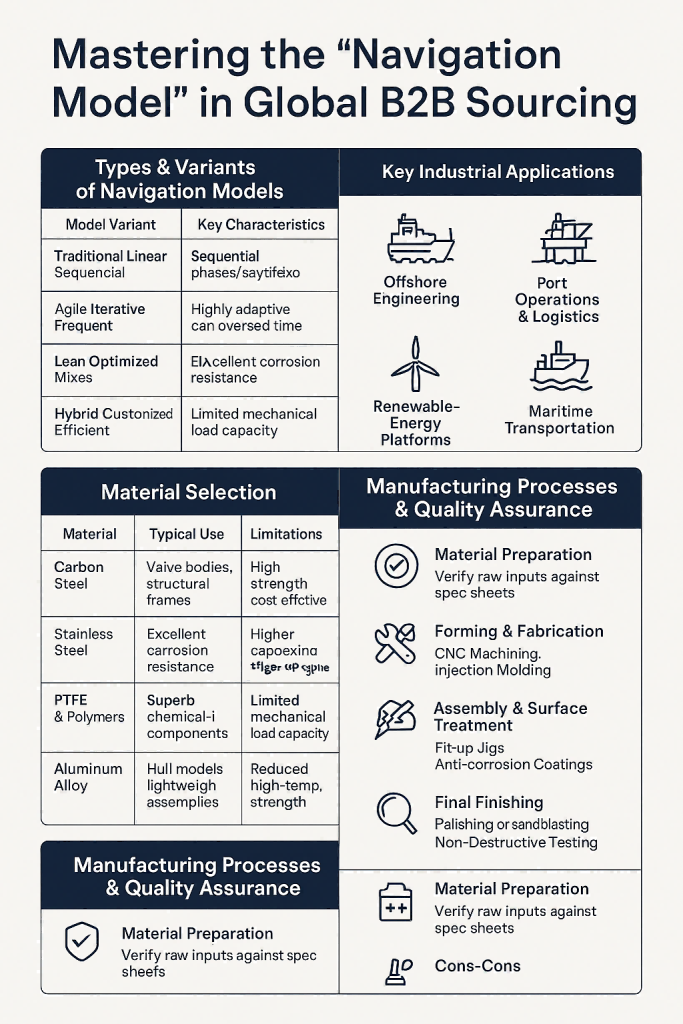
2. Types & Variants of Navigation Models
| Model Variant | Key Characteristics | Ideal B2B Use Cases | Pros & Cons |
|---|---|---|---|
| Traditional Linear | Sequential phases (Plan → Execute) | Ship design, large capital buys | + Easy to manage – Rigid to change |
| Agile Iterative | Frequent feedback loops | Software tools, R&D projects | + Highly adaptive – Can overspend time |
| Lean Optimized | Waste reduction, process streamlining | Manufacturing, supply chains | + Lower cost – Complex setup phase |
| Hybrid Customized | Mix of linear, agile, lean elements | Mega-projects, turnkey solutions | + Flexible – Complex governance |
| Ecosystem-Driven | Networked partnerships, shared data | Industry alliances, joint ventures | + Innovation boost – Dependent on partners’ stability |
3. Key Industrial Applications
- Shipbuilding & Vessel Design
- Use: 3D modeling, structural analysis, performance optimization
- Buyer Value: Enhanced fuel efficiency, lower build costs
- Procurement Focus: CAD software compatibility; metallurgical certifications
- Offshore Engineering
- Use: Seabed structure simulation, fatigue testing
- Buyer Value: Improved safety margins, reduced maintenance
- Procurement Focus: Material corrosion resistance; installation expertise
- Port Operations & Logistics
- Use: Cargo handling workflows, berth-assignment algorithms
- Buyer Value: Faster turnarounds, higher throughput
- Procurement Focus: Hardware interoperability; adherence to ISO safety standards
- Renewable-Energy Platforms
- Use: Wind-farm layout optimization, mooring line dynamics
- Buyer Value: Maximized power output, minimized downtime
- Procurement Focus: Environmental-qualification reports; geospatial analytics
- Maritime Transportation
- Use: Route-planning engines, weather-routing integrations
- Buyer Value: Reduced bunker consumption, on-time delivery
- Procurement Focus: Data-feed SLAs; compliance with IMO regulations
4. Material Selection: Balancing Performance & Cost
| Material | Typical Use | Key Advantages | Limitations | Relative Cost |
|---|---|---|---|---|
| Carbon Steel | Valve bodies, structural frames | High strength, cost-effective | Prone to corrosion without coating | Low |
| Stainless Steel | Marine piping, fittings | Excellent corrosion resistance | Higher CAPEX, complex fabrication | High |
| PTFE & Polymers | Chemical-handling components | Superb chemical & temp. resistance | Limited mechanical load capacity | Medium |
| Aluminum Alloy | Hull models, lightweight assemblies | Light weight, good strength-weight ratio | Reduced high-temp strength | Medium |
Buyer Tips:
- In Arabie Saoudite and other corrosive-prone regions, demand stainless grades certified to ASTM A240 or equivalent.
- German buyers should insist on DIN or EN certifications for marine alloys.
- South American purchasers may prioritize eco-certified polymers to align with tightening environmental regulations.
5. Manufacturing Processes & Quality Assurance
- Material Preparation
- Goal: Verify raw inputs against spec sheets (e.g., chemical composition, tensile strength).
- QC Checks: Incoming-inspection via spectrography, hardness testing.
- Forming & Fabrication
- CNC Machining for metal hull segments—delivers ±0.1 mm tolerances.
- Injection Molding for polymer fittings—ideal for volumes >10,000 units.
- Assembly & Surface Treatment
- Fit-up Jigs ensure repeatable alignment.
- Anti-corrosion Coatings (e.g., epoxy primers, zinc-rich paints).
- Final Finishing
- Polishing or sandblasting for aesthetic and functional surface quality.
- Non-Destructive Testing (ultrasonic, radiographic) to catch subsurface flaws.
- Compliance & Certifications
- ISO 9001 for quality-management systems
- CE Marking for EU market entry
- API or ABS approvals for offshore equipment
Supplier Verification:
- On-site audits to observe shop-floor practices
- Third-party lab tests to confirm in-house QC data
- Supplier scorecards tracking delivery, defect rates, and corrective-action follow-through
6. Comprehensive Cost & Price Breakdown
| Cost Element | Description |
|---|---|
| Materials | Market-price volatility in steel, polymers, alloys |
| Labor | Regional wage differentials (Africa vs. Europe) |
| Overhead | Utilities, equipment depreciation, floor space |
| Tooling/Molds | One-time CAPEX, amortized over production volume |
| Testing/Cert. | Lab fees, inspector travel, certification bodies |
| Logistics | Freight, customs duties, insurance |
| Supplier Margin | Typically 10–25 % depending on market competition |
Cost Drivers & Buyer Strategies:
- Leverage economies of scale by consolidating orders above a supplier’s MOQ.
- Negotiate total-cost-of-ownership (TCO) contracts that bundle maintenance, spares, and training.
- Opt for FCA/FOB terms to control inland transport, or CIF when overseas freight rates are favorable.
7. Best Practices for B2B Buyers
- Define Clear Specs Up Front
- Precise technical, regulatory, and performance requirements minimize scope creep.
- Adopt a Phased Procurement Approach
- Prototype → Pilot → Production: Mitigates risk and spreads investment.
- Scorecard Your Suppliers
- Track KPIs such as on-time delivery, defect density, and responsiveness.
- Embrace Digital Collaboration
- Use cloud-based RFP platforms with version control and real-time Q&A.
- Plan for Lifecycle Support
- Negotiate spare-parts kits and extended warranties as part of the initial contract.
Conclusion
By mastering the Navigation Model, global B2B buyers can transform complex maritime sourcing into a structured, transparent voyage—charting every phase from material selection and manufacturing to quality assurance and total-cost optimization. Whether you represent a port operator in Brazil, an offshore engineer in Nigeria, or a shipyard in Germany, this framework empowers you to steer your procurement strategy toward timely delivery, regulatory compliance, and sustainable profitability.


 Français
  English
  Dansk
Dansk  Deutsch
  한국어
한국어  Italiano
  Suomi
Suomi  Bahasa Indonesia
  日本語
日本語  Polski
  Português do Brasil
  简体中文
简体中文  Türkçe